Today's data
OutputsContainsText, images, video and code
ShowsWhat people produced
MissingHow the result was reached
Play is fundamental to human nature, and it is where people most honestly reveal how they think, adapt and perform. Skillprint reads real gameplay and turns it into strengths: for the people playing, and for the enterprises, developers and AI labs building around them.
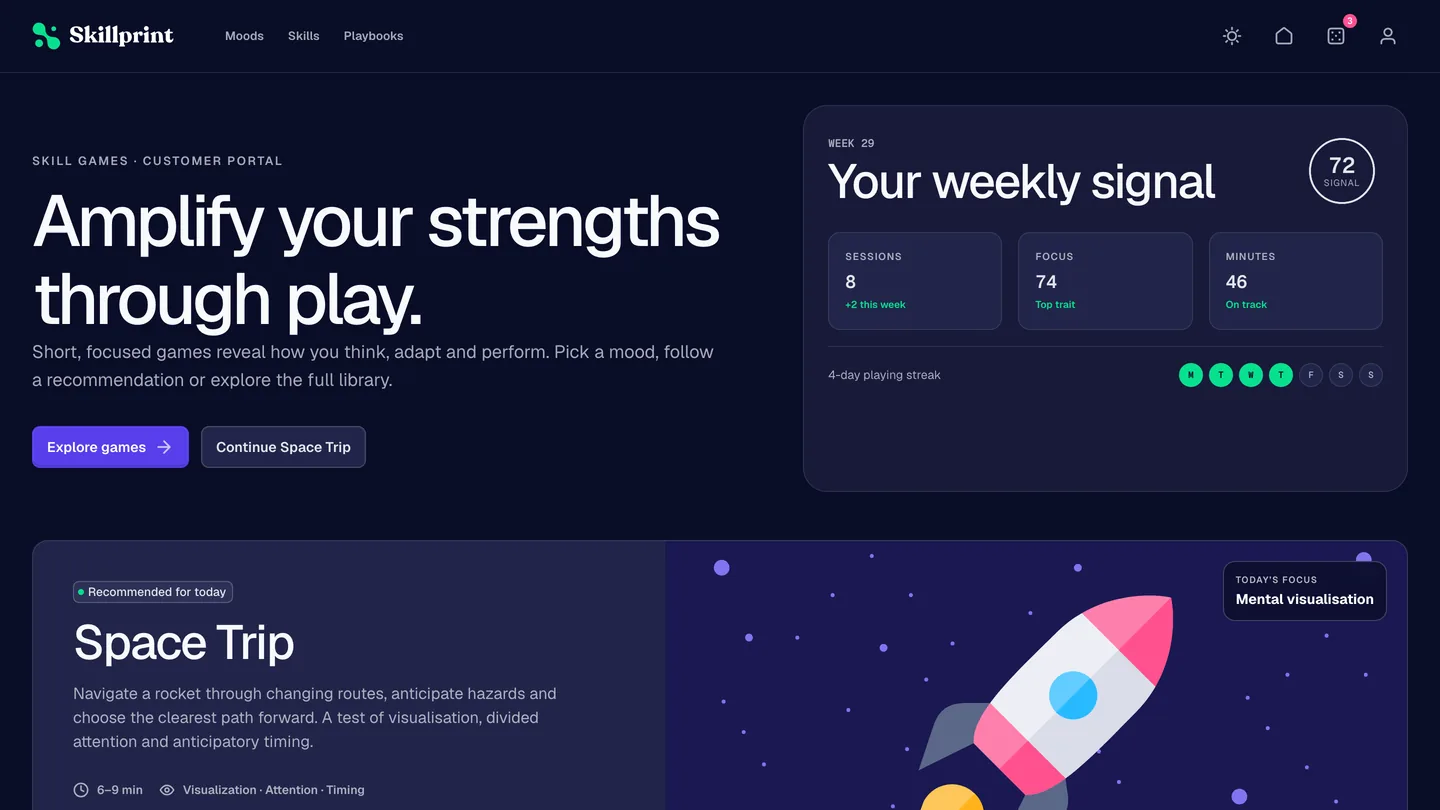
Models are trained on outputs. The process that produced them is missing from the record: the decisions, the adaptation, the emotion, the collaboration.
From Deep Blue to Cicero, games have repeatedly unlocked new machine capabilities. Skillprint extends that precedent in the other direction: turning human gameplay into a measure of how people actually reason.
“Games are a microcosm of reality”
Demis Hassabis · Google DeepMind
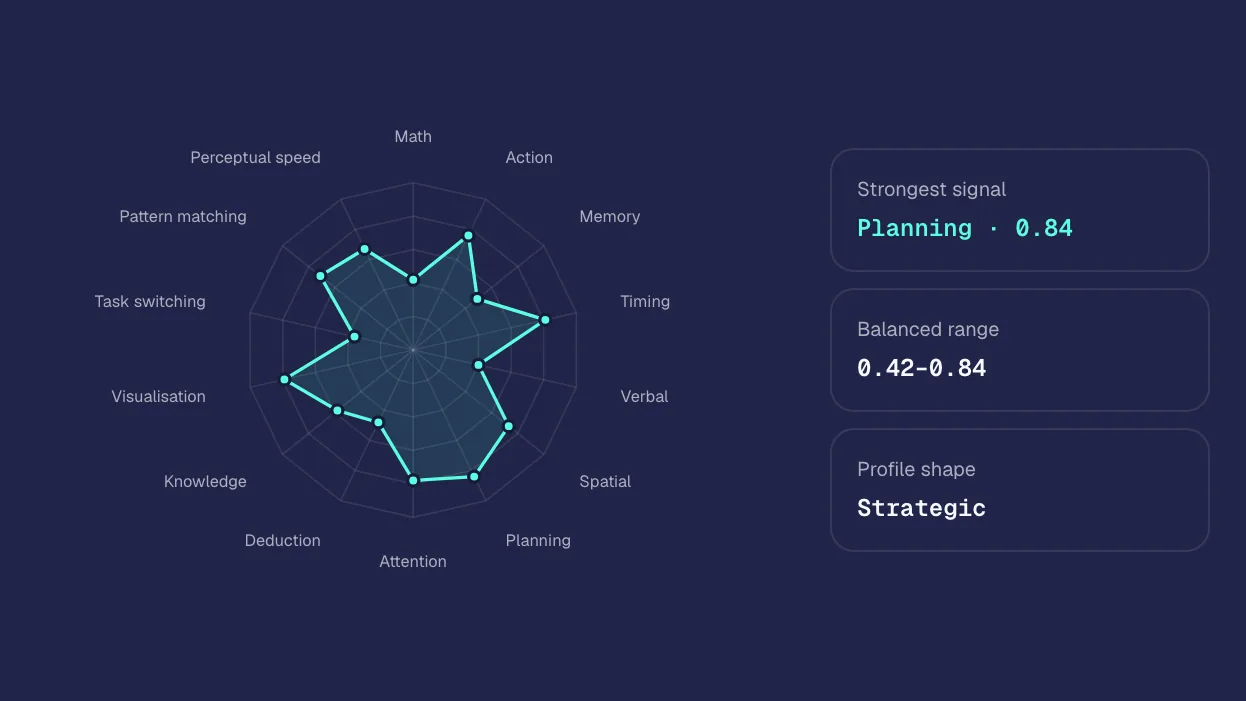
The model and its ontology map play patterns into comparable cognitive, emotional and collaboration strengths. It is the layer that connects the player portal, Flow and the Signal benchmark.
Desired and achieved states such as focus, relaxation, energy and emotional balance. Nine mindsets in the current model.
Pattern matching, attention, memory, reasoning, planning and reaction. The cognitive skill set, read from how a session is played.
Stable traits and preferences that help interpret engagement and individual differences. Five traits across the ontology.
The mapping between game mechanics and human performance is grounded in published neuropsychology, not invented for the product. Over 800 studies inform how mechanics are linked to cognition, mood and personality, and 150+ game mechanics are mapped to the signals a session can produce.
A team with exits, platform scale, research depth and enterprise route to market experience.
CEO & Founder
Founded Playnomics, acquired by Unity. Platform data reached 2B+ devices monthly.
CTO
AI and ML leader, fintech CTO and Berkeley M.S. in Data Science.
Lead Research Scientist
Stanford Language Cognition Lab. Former Assistant Professor of AI.
Head of BD
Former SVP at Esports League, THQ and Playnomics. 20+ years in business development.
COO / Tech Ops
Former COO and CTO across EA Sports studios. Former VC and Playnomics investor.
Product / Board
Founded Mesmo, acquired by GSN. Built products reaching 75M+ users and $100M+ revenue.
Each session strengthens the model, the benchmarks and what every participant receives back. That is why the ecosystem is built as one loop rather than three separate products.
See how it worksReal games people want to return to produce continuous behavioral signal.
playEvery session adds labeled evidence to the model and its ontology.
labelBetter labels make the human+AI benchmarks sharper and more useful to researchers.
measureEach product returns more value as the others grow, which brings more sessions.
compoundExplore the products or speak with Skillprint about the path that fits your organization.