Signal · AI Labs
AI understands the task. Not the person doing it.
Useful AI has to be human-context aware. It needs to know how someone thinks, acts and feels, not just what's on the screen. Skillprint captures that context from real gameplay: rights-cleared, player-consented data on how people decide, adapt, feel and perform.
Research, white papers and the live benchmark are at skillprint.co/benchmark.
The human context it's missing
Only from real playWhy gameplay
Games are where people show how they think, act and feel.
Every decision, retry and mood shift happens against a known world state. Skillprint records both on one timeline, so the data shows what happened and why.
What you receive
One session. Up to six synchronized views of the human and the world.
Each stream is keyed to the same session and timeline, and can be delivered together as model-ready bundles.
01
Visual stream
Timestamped screenshots and/or video of real human play, ordered by session and time.
what happened02
Game-state stream
Game, level, configuration, objects, goals, points, outcomes, physics and real-time difficulty changes.
the world03
Player state and decisions
Cognitive skill levels, mindset, experience, controller inputs, goals, strategies and outcomes.
the decision04
Cognition, flow and mood
Assessed cognitive skills plus flow and mood signals, with a human-reviewed golden subset.
human state05
Human ground truth
Player-reported mood and blind A/B experiment arms, including a non-AI-assisted control.
ground truth06
Longitudinal profiles
Session- and player-level scores across 14 cognitive skills and 9 moods, tracked over time.
over time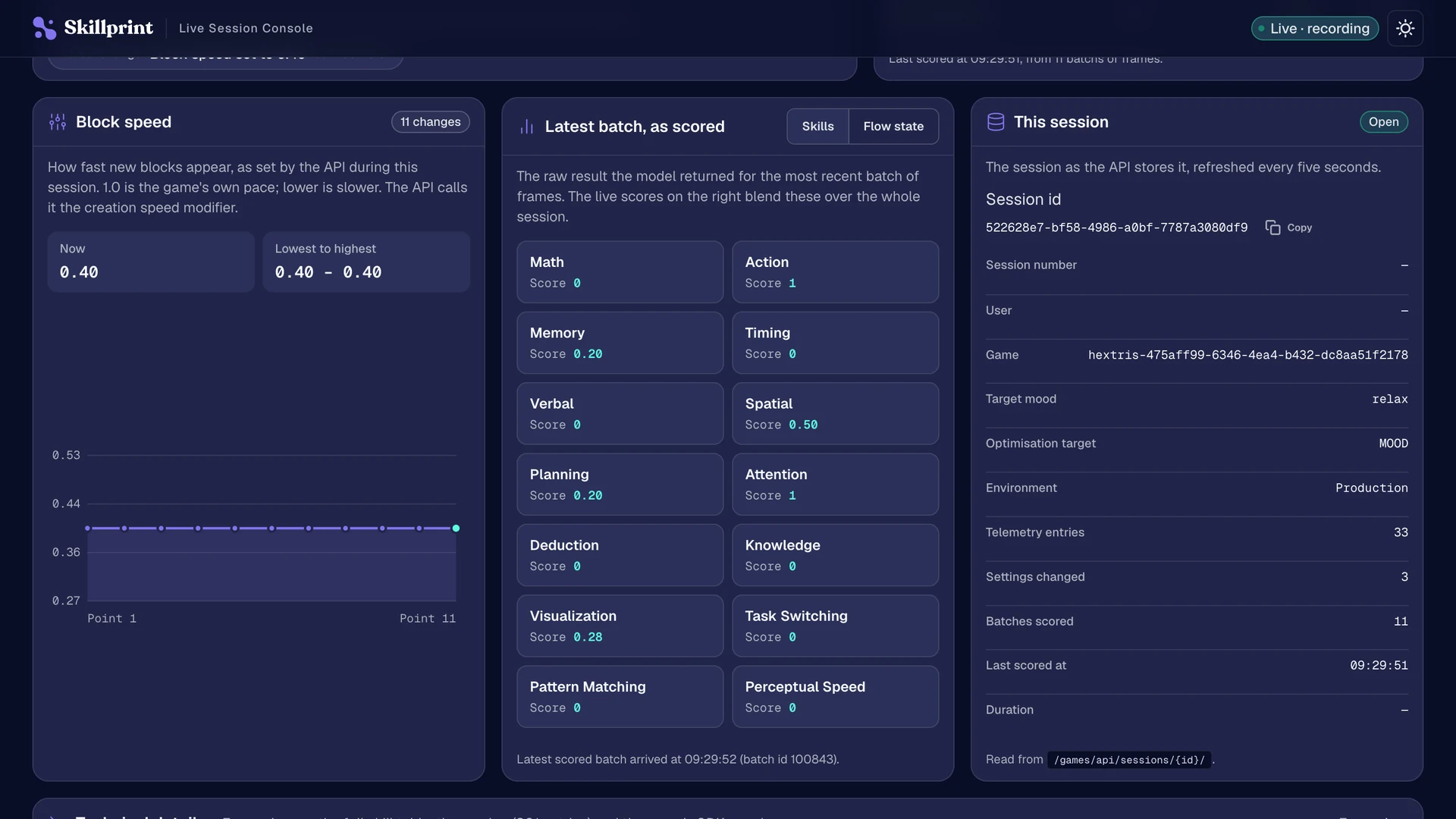
The dataset
Each configured session is a labeled reasoning example.
Gameplay captures the process behind an outcome: the world state, the decision, the player's cognitive and emotional state, what happened next, and how that same player changes over time.
Discuss your data needs01
Real world relevance
Gameplay maps to how people actually reason and decide under changing conditions, not to how they describe it afterward.
relevance02
Structured labels at scale
Session data is synchronized against one timeline, making visual state, telemetry, cognition, flow, mood, controls and outcomes directly comparable.
labels03
Collected from real play
Human gameplay comes from real players across partners’ live games rather than only hired or curated capture sessions.
live play04
Rights and consent built in
Data streams are sourced from rights-cleared games and are player-consented and anonymized before delivery.
provenanceWhat it answers
Where do humans and AI perform best together?
The data carries blind A/B arms and a non-AI-assisted control, so it answers questions a model-only leaderboard structurally cannot.
01
Does this model actually improve the person using it?Measured against the same person's unaided baseline, in the same task, on the same day.
02
Which model amplifies which kind of person?Lift is not uniform. A model that helps a cautious planner may do nothing for a fast improviser.
03
Where is the human still better alone?The control arm runs with no AI in the loop, so the cases where assistance hurts are visible rather than assumed away.
04
What does the lift cost?Goal attainment scored beside token cost and latency, so efficacy is judged against what it took to get there.
What labs can do
Does your AI actually understand the person it's working with?
Most can't show it yet. The same corpus supports five ways to build models that do, from fine-tuning a world model to proving a system helps the person using it.
01 · adaptation
World-model adaptation
Fine-tune on state to action to next-state pairs across multiple environments and human/agent strata.
02 · reasoning
Reasoning and planning
Learn from decisions, strategies, outcomes and cognitive-skill labels rather than action traces alone.
03 · personalization
Personalization
Study how the same environment and intervention affect people with different cognitive, mood and experience profiles.
04 · evaluation
Human+AI evaluation
Use blind A/B arms, unaided controls and human-reported outcomes to measure whether systems genuinely improve performance and experience.
05 · recovery
Failure, recovery and adaptation
Capture unsuccessful attempts, strategy changes, retries and recovery paths so models can learn how people recognize errors and revise their approach.
Work with us
Tell us what you want to measure.
Three ways to work with us: license the gameplay data we already hold, commission collection built to your spec, or benchmark your models against real human play.
01
LicenseExisting human intelligence gameplay datasets.
02
CommissionRights-cleared collection around a target environment or action vocabulary.
03
BenchmarkBuild a human+AI benchmark around the outcome your team cares about.
The benchmark
See how models score against real human play.
A leaderboard position says a model is good at the benchmark. It says nothing about whether a person got further with it in their hands. Signal scores people unaided, AI alone, and people amplified by AI inside real games. The live leaderboard sits on the benchmark page.